
Why window repair becomes a must in Europe
This article is intended for carpenters, real estate managers and building maintenance professionals in France (Paris, Lyon, Marseille, Bordeaux) as well as throughout Europe (Germany, Belgium, Spain). He explains why, in 2026, repairing an aluminum or PVC window rather than replacing it is no longer just a good practice: it has become an economic, regulatory and ecological reflex.
Find the right spare aluminium carpentry piece on DirectAlu.com
1. The rise in raw materials makes the new ever more expensive
The first engine is economical. The price of aluminum, which is the basis of any aluminium carpentry, has seen a marked surge: it was rated at the London Metal Exchange, over $3,600 per tonne in the spring of 2026, against historically low global stocks and structural supply pressures.
The analysts no longer speak of a mere cyclical peak but of a pivotal year: demand driven by the energy transition (electric vehicles, solar panels, wind turbines) is confronted with a constraint supply, notably by the capping of Chinese production. In Europe, buyers also pay a regional premium of several hundred euros per ton, increasing, which covers transport and provision.
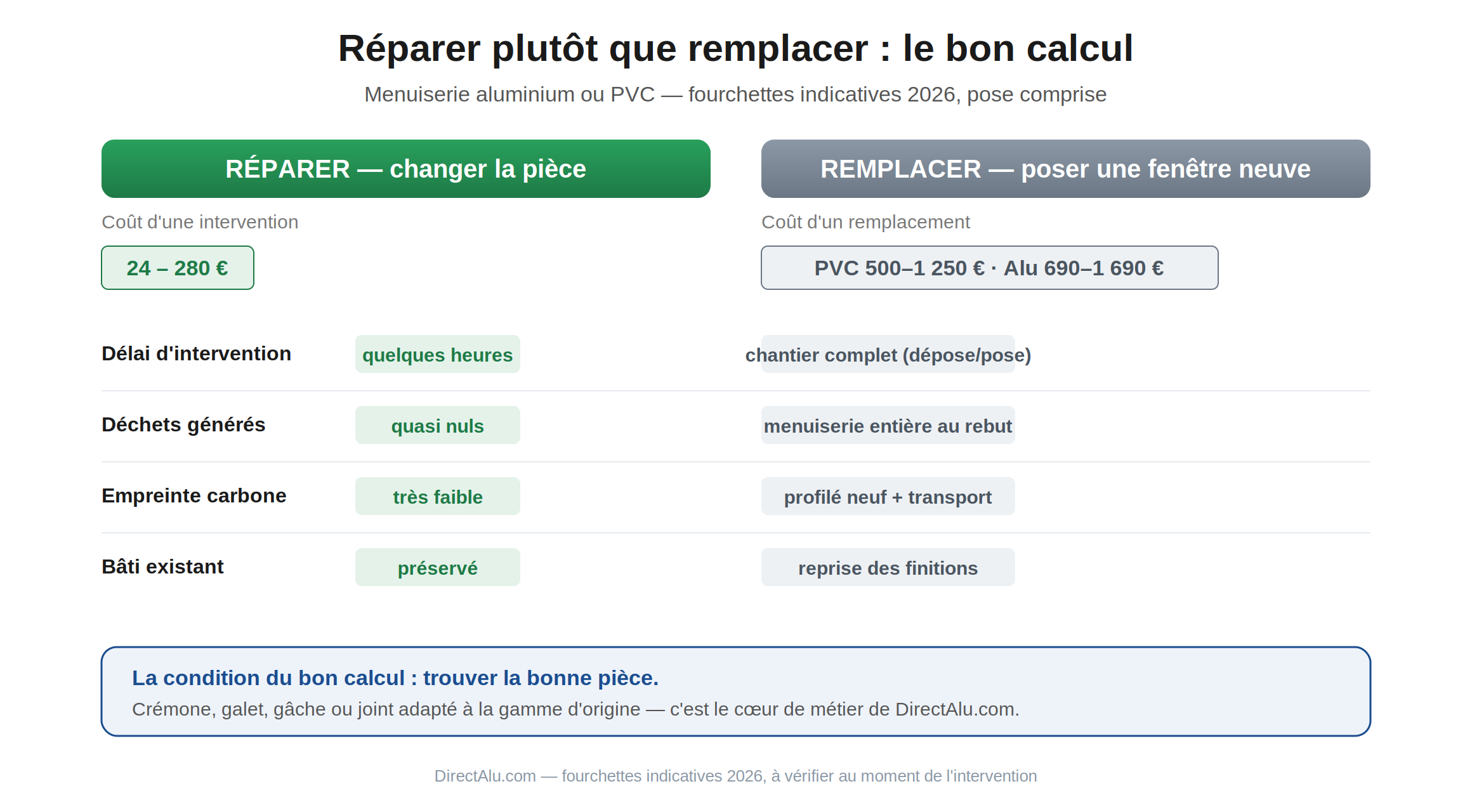
PVC does not escape the trend: derived from petrochemicals, its cost remains exposed to the volatility of energy and hydrocarbons. As a result, on the windows side: replacing a carpentry is now expensive. Taking into account the latest increases, the change in a window is usually between €500 and €1,250 made of PVC and between €690 and €1,690 made of aluminium, including a window — and much more for a window.
2. Repairing is much cheaper than replacing
This is the most concrete argument for your clients. In the vast majority of cases, a window that malfunctions does not need to be replaced: it is its hardware that is involved. However, the replacement of a detached piece is in tens of euros, where a new carpentry is in hundreds or even thousands.
The price ranges found in 2025-2026 speak for themselves:
- Handle or cremon: from 24 to 160 € (including labour).
- Seal: about 32 to 72 €.
- Targeted repair on aluminium carpentry: often 120 to 280 € depending on the type of opening.
- Complete replacement of an aluminium window: 690 to 1 690 €, excluding glazing.
3. A European regulatory framework that shifts to repair
Beyond the economy, regulation is moving in the same direction. The European Union adopted Directive (EU) 2024/1799 on the right to reparation, which entered into force on 30 July 2024. The Member States must have transposed it and apply it from 31 July 2026 — a deadline which is now very close.
This directive is part of the Green Pact for Europe and the Action Plan for a circular economy, with a clear objective: to make repair easier, faster and more attractive than replacement. In particular, it introduces a repair obligation for manufacturers of goods subject to repair requirements, a European repair service information form, an extension of the legal guarantee in the event of repair, and a European platform for finding repairers. The list of products concerned will be expanded in line with the new repair requirements.
The message to the market is unambiguous: "repair rather than throw" becomes the reference standard in Europe. The building professionals have every interest in getting ready for it now.
4. A citizens' approach that improves CSR performance
Repairing is also a high-impact environmental choice. Each year, disposing of repairable goods generates about 35 million tonnes of waste in the European Union. Extending the life of a carpentry avoids the production of a new, energy-efficient raw material profile and reduces the carbon footprint of the building.
For a company, this logic translates directly into the CSR balance sheet. Focusing on repair is:
- Reducing site waste and reduce the volume of carpentry scrapped.
- Reduce carbon footprint avoiding extraction and processing of new raw materials.
- Limiting dependency imports of raw materials and supply tensions.
- Valorize responsible image to clients, donors and donors who are increasingly attentive to these criteria.
For an artisan as for a real estate manager, repairability becomes a real commercial argument and differentiates.
5. Added arguments
Other, more discreet factors further reinforce the trend:
- Rapidity of intervention: replacing a piece takes a few hours, where the replacement of a carpentry mobilizes a complete construction site (laying, laying, recovery of finishes).
- Preservation of existing buildings: In a protected or heritage area (ABF notice), repair avoids touching original carpentry sometimes irreplaceable to the same.
- Less harmful to the occupant: No big work, no housing rendered uninhabitable the time of work.
- Customer loyalty: propose repair where possible establishes a lasting relationship of trust, more profitable in the long term than a single sale.
6. The nerve of war: finding the right piece, fast
All of these arguments face a single practical obstacle: on an old range, finding the exact reference of a cremon, a sliding bay scoop or a waste is often a puzzle. The brands are numerous (Technal, Schüco, K-Line, Reynaers, Wicona, Giesse, Savio, Fapim...) and the pieces rarely marked.
It is the vocation of DirectAlu.com: a B2B marketplace that brings together the aluminium carpentry spare parts of major manufacturers, with listed technical data sheets, unit sales and fast delivery throughout Europe. And when the range is definitely exhausted, our industrial network allows us to remanufacture some custom parts — to repair where others would force everything to change.
Order my spare aluminium carpentry parts on DirectAlu
Frequently Asked Questions
Is repairing a window really cheaper than replacing it?
In the vast majority of cases, yes. The replacement of a piece of hardware is in tens of euros, against several hundred to more than thousand euros for a new window laid. The gain is net once the right piece is identified.
Does the repair also concern PVC windows?
Yes. Cremones, handles, pebbles, spoils and joints replace themselves on PVC carpentry as aluminium. The economic and ecological logic is identical.
What does the European law on reparation say?
Directive (EU) 2024/1799 on the right to reparation, in force since July 2024, must be applied by Member States from 31 July 2026. It aims to make repair more attractive than replacement in the European circular economy.
Also read: Top 10 most frequent troubleshoots in aluminium carpentry · Replace a window cremon alu step by step.
Sources: London Metal Exchange and market analysis 2026 (aluminium prices); price guides Works.com 2025-2026 (window repair and replacement); Directive (EU) 2024/1799 and European Parliament (right to reparation, circular economy). Indicative figures, to be checked at the time of publication.