
Top 10 most common aluminium carpentry failures (and their solutions)
It identifies the ten most common failures in aluminium carpentry — windows, doors and sliding bays — and details, for each, the symptom, probable cause and repair solution with the right aluminum hardware. In the field, the vast majority of the malfunctions of a window or aluminium door do not come from the profile itself, but from its hardware: cremone, handle, pebbles, waste, joints or doormats. Good news: in almost all cases, it is enough to replace a detached piece of aluminium carpentry rather than the whole carpentry. Here's how to diagnose and repair quickly.
Find the spare part you need on DirectAlu.com
1. The aluminium window no longer locks (HS cremon)
Cremone is the most popular mechanism in an aluminum window. Through manipulation, it ends up fluttering or breaking, and the locking points no longer deploy.
Symptoms : The handle rotates in the vacuum or remains blocked, the opening no longer closes waterproofly.
Probable cause : Used Cremona or broken internal mechanism; Uncoupled rods.
Solution : Replace the aluminium cremon with an identical reference. Lift the attachment centreline, the depth of the fingers draining to the back of the cremon (handle) and the rod length before ordering.
See also our guide : How to replace a step by step cremon?
2. The sliding bay hangs or becomes hard to maneuver
A glass bay that forces the opening is the most common sign of tired rolling pebbles.
Symptoms : The vantail hangs, grins or requires a great effort to slide.
Probable cause : Used trolleys (galets), flat or deregulated castors, cracked rail.
Solution : Clean the rail, then replace the carts. Prioritize the body width and height before ordering the right scab.
See also : How do I identify a sliding bay scoop without reference?
3. The window handle is broken or rotates in the vacuum
Symptoms : The handle is cracked, unscrews or no longer causes the mechanism.
Probable cause : Handle cracked by wear, threaded pin screw, worn drive square.
Solution : Change the aluminium window handle and, if necessary, the square rod. Check the screw centreline to ensure compatibility.
4. Air or water infiltration (failure joints)
Air currents or traces of moisture in the dormant almost always betray a dead joint.
Symptoms : Sensation of air current, whistling, condensation or infiltration at the bottom of carpentry.
Probable cause : Hardened, crushed or taken off peripheral joint; leakproofness.
Solution : Replace the aluminium seal adapted to the profile (to hit, clip or slide in the throat). Clean the front throat.
5. The door or window rubs / is wrongly aligned
Symptoms : The flap rubs on the dormant, leaves a slit or firm cross.
Probable cause : Deregulated or worn leaves, carpentry collapsed over time.
Solution : Adjust the mats (side, height, compression). If the wear is too advanced, replace the door or hinge.
6. Wastes no longer lock properly
Symptoms : The closing points no longer hang, the window remains closed.
Probable cause : Deregulated, worn, broken or unaligned waste from the wood.
Solution : Re-align the spoils on the dormant at the backstage; A gap of 1 to 2 mm is sufficient to prevent locking. Replace the waste if it is broken.
7. The oscillating-beating vantail no longer tipping
Symptoms : The oscillating position (blower) is no longer activated or blocked.
Probable cause : Compass, iron or angle return of damaged oscillating hardware.
Solution : Identify the lock mark and replace the compass or angle return. These pieces are specific: raise the gammistic reference if possible.
8. The aluminium shutter is blocked or hard to mount
Symptoms : The apron is difficult to climb, get stuck or make an abnormal noise.
Probable cause : Deformed aluminium blades, broken attachments, used strap or winch, motor at end of life.
Solution : Replace the attached or damaged blades; check the strap, manoeuvre or engine according to the mechanism.
9. Sliding bay threshold leaks or overflows
Symptoms : Water stagnation or infiltration at the lower threshold of the bay.
Probable cause : Escape holes (non-return valves) obstructed, threshold joint failing.
Solution : Clear and clean the drain holes, replace the non-return valves and the threshold seal to restore drainage.
10. Noise, grin or hard spot at locking
Symptoms : Grinding metal or hard point by operating the handle.
Probable cause : Lack of lubrication, dry rods, cracked mechanism.
Solution : Clean the throats, apply a silicone lubricant to the friction points and the pênes. If hardness persists, check the alignment of the spoils.
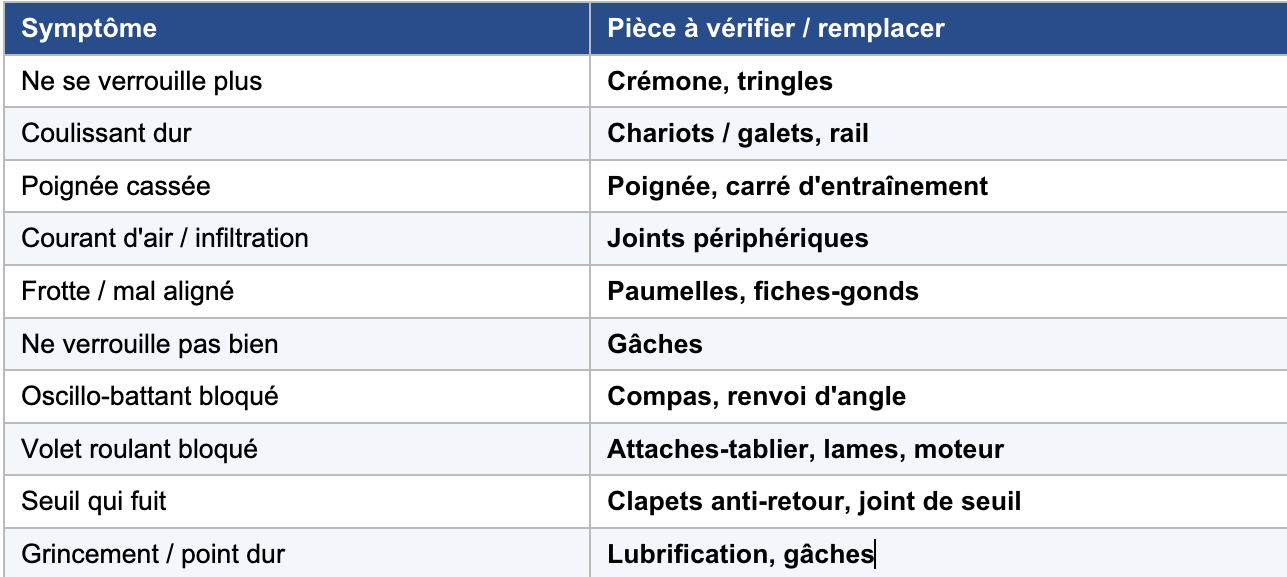
In summary: express diagnosis
A summary table to go to the essentials on the site:
The right piece, first time, with DirectAlu.com
Most of these failures repair with a single piece of aluminium carpentry, without changing the entire window. The real challenge for a professional is to find the exact reference — especially on unmarked old ranges (Technal, Schüco, K-Line, Reynaers, Wicona, Alu K , Profiles Systemes...).
On our marketplace, you order the original hardware unit, with listed data sheets, and you are delivered within a few days throughout Europe. Whether your construction site is in Paris, Lyon, Bordeaux, Berlin or Brussels, we eliminate intermediaries to extend the service life of carpentry shops and promote their repair.
Order my spare aluminium carpentry parts on DirectAlu
Frequently Asked Questions
Should the whole window be changed in case of hardware failure?
No, in the vast majority of cases. Cremona, handle, pebbles, joints or spoils replace each other for a fraction of the price of a new carpentry.
How to find a room reference on an old carpentry?
Demonstrate the piece, raise its key ratings to the backstage foot and compare them to DirectAlu.com's data sheets. If the range is obsolete, we can remanufacture some custom parts.
Are these repairs within the reach of an individual?
Cleaning, lubrication and replacement of a joint are accessible. The change of a cremone, oscillo-beater or flap motor is rather reserved for a skilled craftsman.
Also read: How to identify one. Sliding bay cake without reference? How to replace a Cremone Window Handle Step by Step