
How to Measure Aluminium Window Hardware Accurately Before Ordering
PRO GUIDE — ALUMINIUM HARDWARE METROLOGY
This guide is designed for professional window installers, locksmiths, and building maintenance technicians across the UK and Europe. It explains, by hardware type, how to measure aluminium window components—such as handles, espagnolettes, rollers, locks, keeps, and gaskets—so you can order the right part the first time.
Especially with older or unbranded ranges, accurate geometry is crucial: two parts may look similar but be incompatible by less than a millimetre. Precise measurement means successful orders, no returns, and smooth project progress. Here’s the method.
▸ Compare with dimensioned technical sheets on DirectAlu.com
Getting Started: Tools and Best Practices
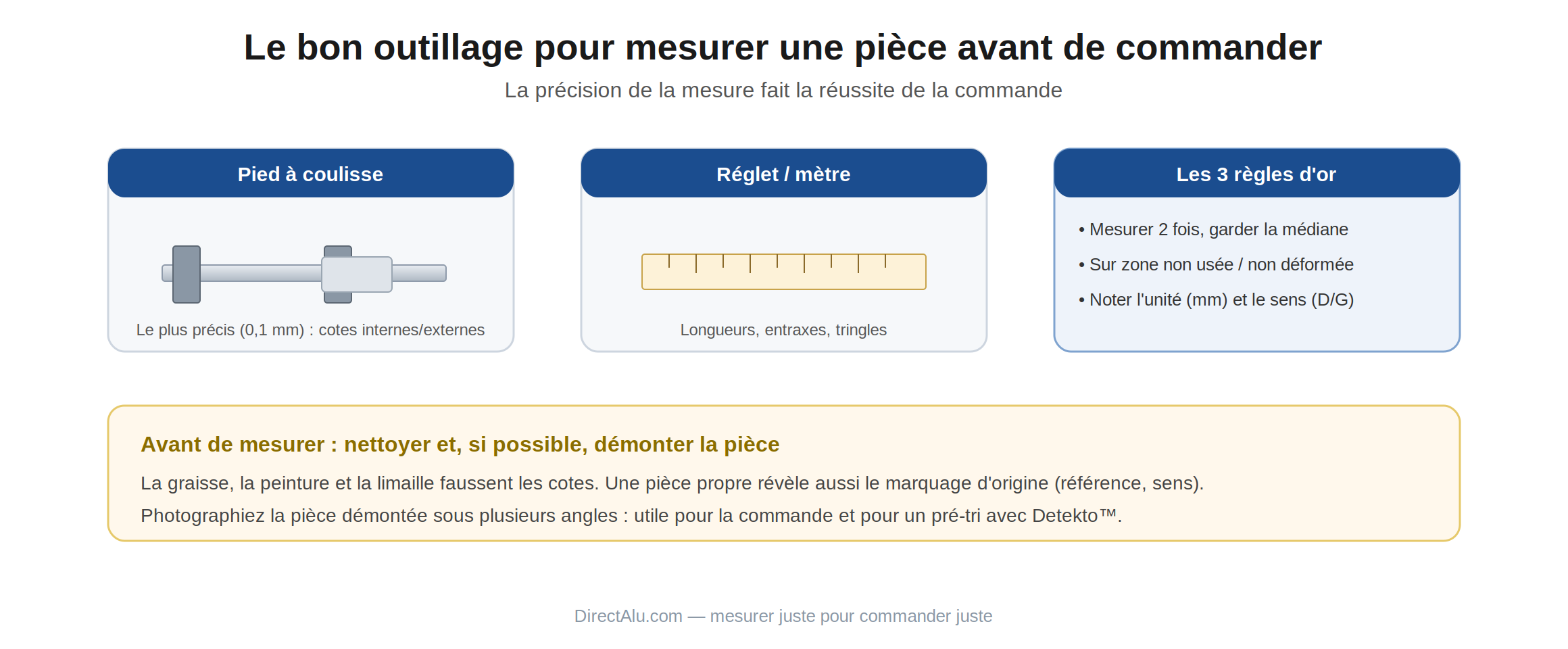
Accurate measurement starts with the right tool and a prepared part. Use a vernier caliper for precise readings (to a tenth of a millimetre); a steel rule or tape measure suffices for longer dimensions and fixing centres. Always clean and, where possible, remove the part before measuring.
The Golden Rule to Avoid Returns
Measure each dimension twice and use the median value, always on a non-worn area. Record the unit (mm) and orientation (right/left). If in doubt, measurement takes precedence over visual similarity.
1. Measuring an Aluminium Window Espagnolette or Handle
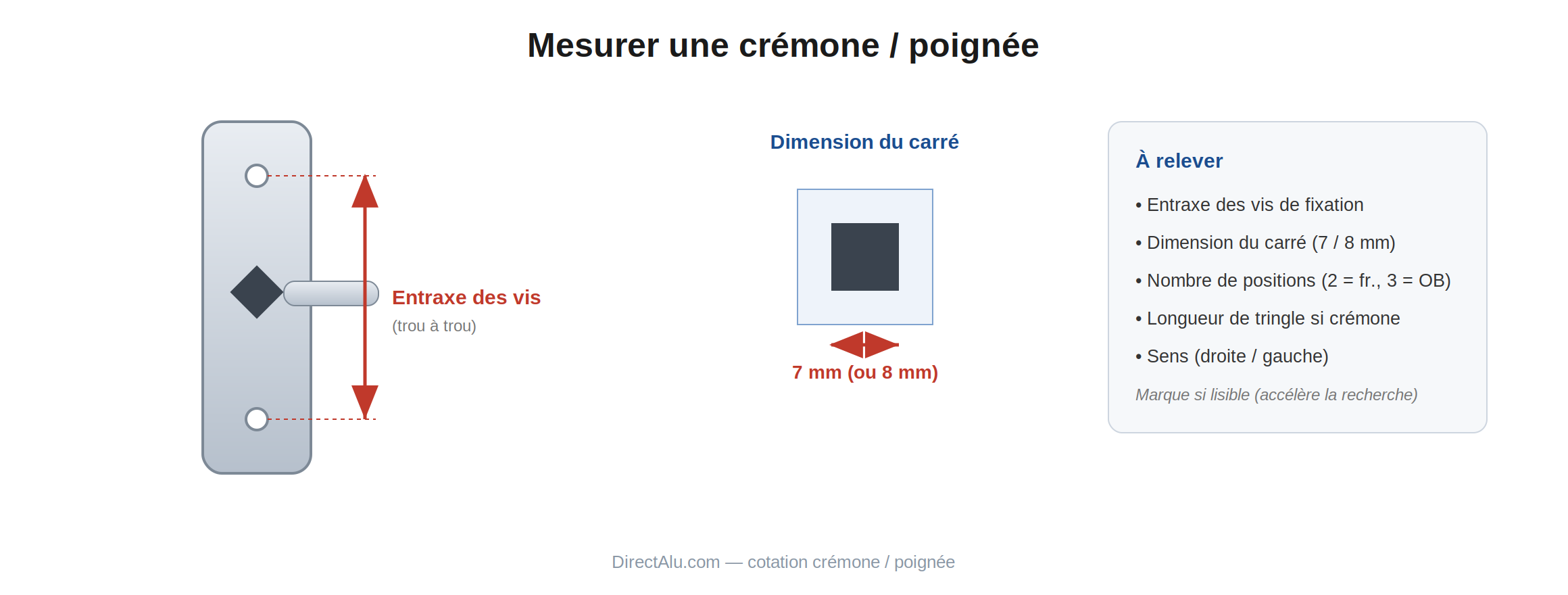
For an aluminium window handle or espagnolette, two key measurements determine compatibility: the fixing screw centres (distance between the two plate holes) and the spindle size, usually 7 mm (sometimes 8 mm). Also note the number of handle positions, which distinguishes a standard espagnolette (2 positions) from a tilt-and-turn (3 positions).
See also: How to identify an aluminium window handle?
2. Measuring a Sliding Door Roller
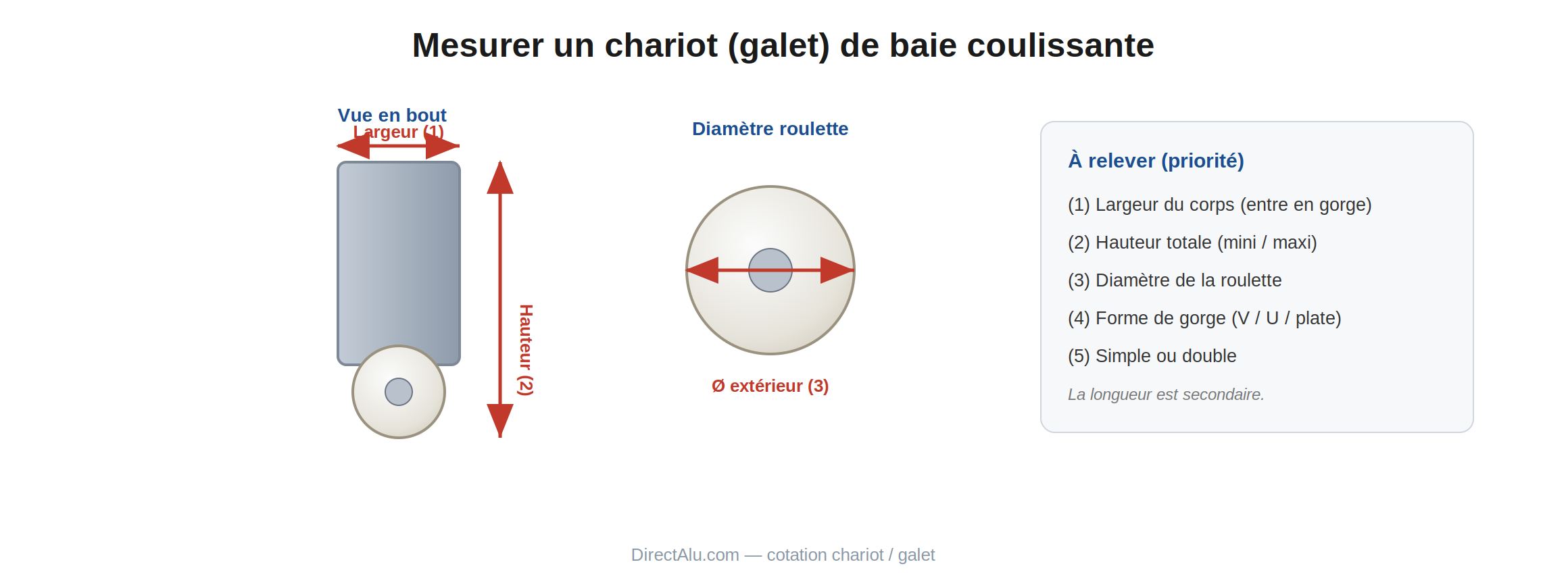
For a roller, focus on the body width (to fit the profile groove) and overall height; length is less critical. Note the wheel diameter, groove shape (V, U, or flat), and whether it’s a single or double roller.
See also: How to identify a sliding door roller without a reference.
3. Measuring a Lock
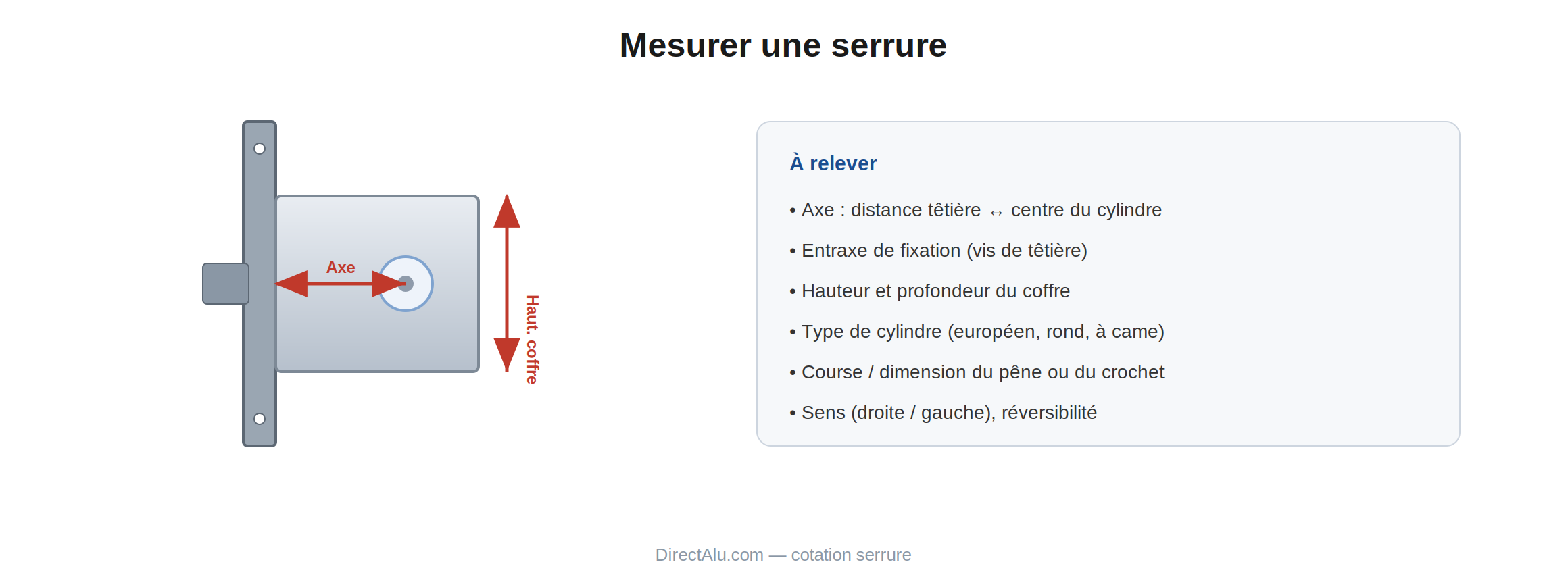
For a lock, start with the backset (distance from the faceplate to the cylinder centre). Then measure the fixing screw centres, case height and depth, and cylinder type (Euro, round, cam). Don’t forget the throw of the latch or hook, the handing (right/left), and the faceplate width (commonly 16, 20, 22, or 24 mm).
See also: How to identify an aluminium window lock?
4. Measuring a Strike Plate or Gasket
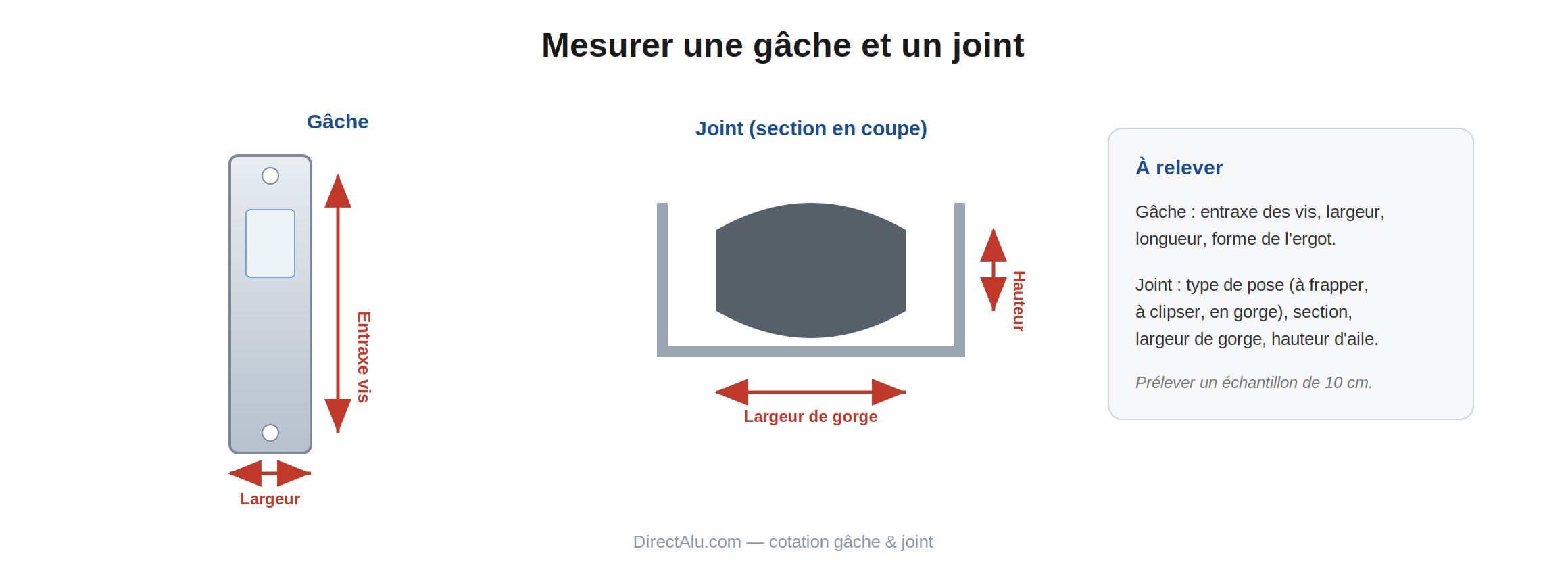
For a strike plate, measure the fixing centres, width, length, and locking lug shape. For an aluminium window gasket, determine the fitting type (push-in, clip-on, or channel), cross-section, channel width, and wing height. The most reliable approach is to take a 10 cm sample for profile comparison.
5. Measuring Machining (Drilling, Cutting, Notching)
Sometimes you need to measure machining on the aluminium profile so a new part fits, or to have a custom piece made. Record:
- The diameter and centres of drill holes—for fixings or spindle passage.
- Cut-out dimensions: length, width, and corner radii for espagnolettes or locks.
- Position relative to a reference edge: measure from the faceplate, edge, or end of the profile.
- Profile thickness: for correct screw length and part compatibility.
Template Tip
For complex machining, create a template: place paper over the area and trace the outline, or photograph the cut-out next to a ruler. This is invaluable for custom fabrication.
6. Detekto™: Speed Up Part Identification
Once you have your measurements, Detekto™—our AI-powered part recognition tool developed with Open Global Solutions (OGSo)—makes the next step faster: take a photo of your part and the tool suggests a shortlist of likely matches. You then compare your measurements with the technical sheets to confirm. Detekto™ guides, but measurement decides.
Try it: Scan my part with Detekto™.
Summary Table: Key Dimensions by Hardware Type
Type | Key Measurements |
|---|---|
Espagnolette / handle | Screw centres, spindle (7/8 mm), number of positions, rod length, orientation. |
Roller / carriage | Body width, min/max height, wheel diameter, groove shape, single/double. |
Lock | Backset (faceplate ↔ cylinder), fixing centres, case height/depth, cylinder type, orientation. |
Strike plate | Screw centres, width, length, lug shape. |
Gasket | Fitting type, cross-section, channel width, wing height (10 cm sample). |
Machining | Drill diameter/centres, cut-out dimensions, reference edge, thickness. |
Measuring Well: A Sustainable Practice
Taking accurate measurements means ordering the right part—so you repair the window, not replace it. Every window saved avoids the need for new aluminium profiles, a resource-intensive material, and reduces site waste. Careful measurement is the first step in a circular economy for building maintenance: good for your margins and your sustainability record.
From Measurement to Sustainable Repair
By selling individually, promoting cross-brand compatibility, and custom-manufacturing obsolete parts from your dimensions, DirectAlu.com makes repair possible where others would require full replacement.
▸ Find and order your part on DirectAlu.com
Frequently Asked Questions (FAQ)
How do I choose an aluminium window handle that fits my profile?
To select a compatible aluminium window handle, measure the fixing screw centres and spindle size, and check the handle's number of positions. Compare these with your profile and technical data sheets to ensure a proper fit.
Which espagnolette is suitable for a casement aluminium window?
For a casement aluminium window, choose an espagnolette with the correct rod length, fixing centres, and spindle size. Always match the number of handle positions and orientation to your window's function.
How can I replace an aluminium window handle myself?
First, measure the screw centres and spindle size of your existing handle. Remove the old handle, align the new one, and secure it with the appropriate screws, ensuring the spindle fits the mechanism correctly.
When should I replace the gaskets on my aluminium window?
Replace aluminium window gaskets when you notice draughts, water ingress, or visible wear such as cracking or loss of elasticity. Proper gaskets ensure insulation and prolong the window's lifespan.
FAQ
How do I choose an aluminium window handle that fits my profile?
To select a compatible aluminium window handle, measure the fixing screw centres and spindle size, and check the handle's number of positions. Compare these with your profile and technical data sheets to ensure a proper fit.
Which espagnolette is suitable for a casement aluminium window?
For a casement aluminium window, choose an espagnolette with the correct rod length, fixing centres, and spindle size. Always match the number of handle positions and orientation to your window's function.
How can I replace an aluminium window handle myself?
First, measure the screw centres and spindle size of your existing handle. Remove the old handle, align the new one, and secure it with the appropriate screws, ensuring the spindle fits the mechanism correctly.
When should I replace the gaskets on my aluminium window?
Replace aluminium window gaskets when you notice draughts, water ingress, or visible wear such as cracking or loss of elasticity. Proper gaskets ensure insulation and prolong the window's lifespan.